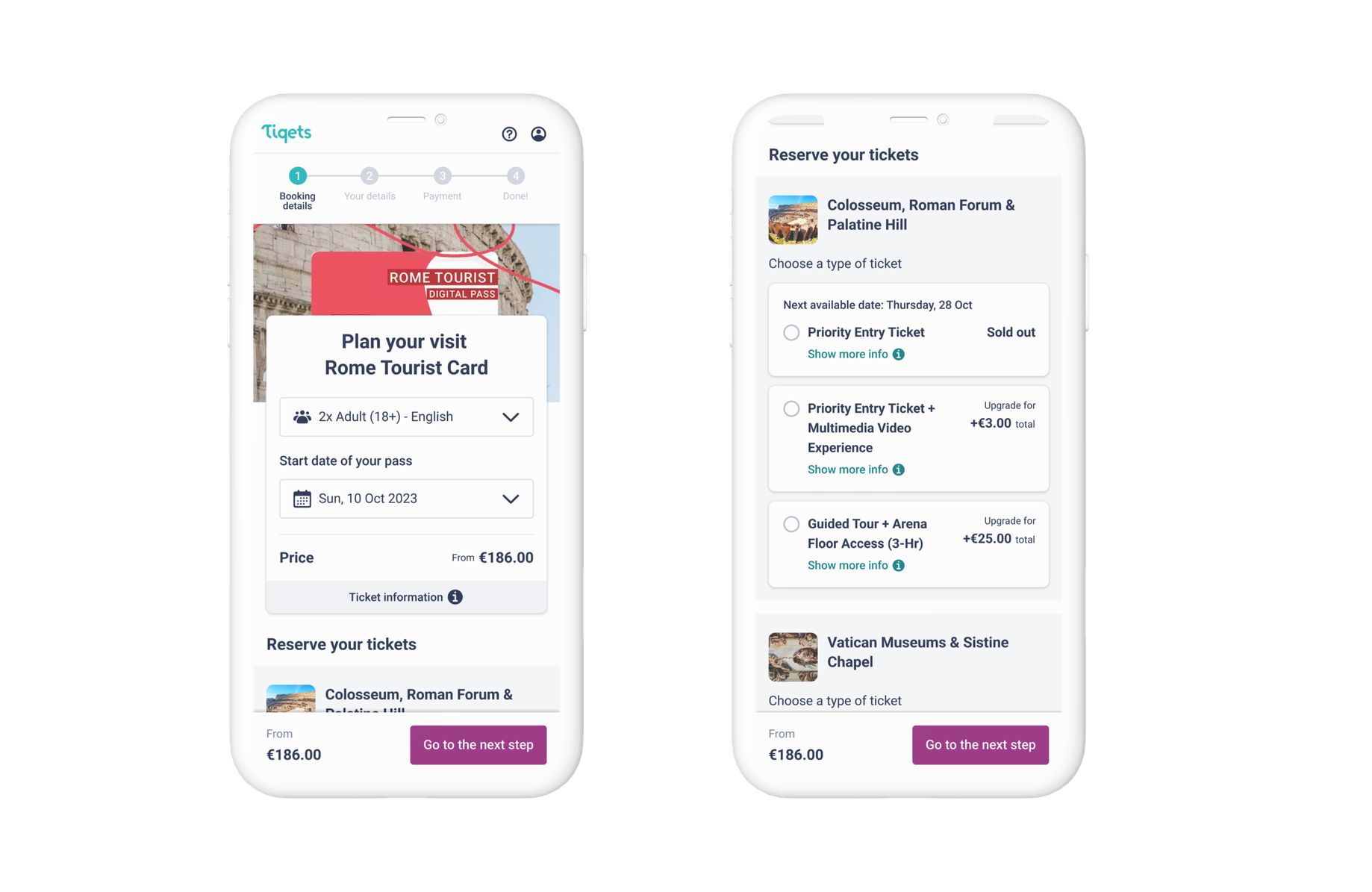
The Rome Tourist Card is a product sold by Tiqets that contains a group of tickets to visit the main attractions of Rome. One of the issues with the card is that if any of the included products sells out, the entire card becomes unavailable. This often poses a problem, especially with popular venues like the Colosseum. In practice, this means that customers are only able to book the Rome Tourist Card at least 20 days in advance, causing frustration to a large group of last-minute bookers on the platform.
Problem statement
If any ticket inside the Rome Tourist Card sells out, the whole card becomes unavailable — pushing last-minute bookers out entirely.
My role
UI/UX Design, Prototyping & User testing
Goals
- Maximise the availability of the Rome Tourist Card
- Increase conversion rate by 10% through availability and easier alternative selection
- Increase total net margin from the Rome Tourist Card
Solution
Increase the availability of the Rome Tourist Card by offering customers alternative ways to visit an attraction for a small increase in price.
Impact
- +138% increase in conversion rate
- +63% increase in gross margin per user
- New sales record for the Rome Tourist Card in the first month of implementation
Research
As one of the most popular products from Tiqets, the Rome Tourist Card offers a convenient way for travellers to book tickets to Rome's main attractions: the Colosseum, the Vatican Museums & St. Peter's Basilica.
But because of how popular these venues are, this product also suffers from availability constraints. If any of the tickets included in the card are sold out, the whole card becomes unavailable as a result.
This meant that travellers who tried to book this product were often experiencing frustration: they couldn't book the card for the date they needed it.
In an attempt to increase the availability & CVR of this product, our team wanted to experiment with offering alternative products in case one of the tickets is sold out (e.g. in case a regular entry ticket is sold out, offer a Guided Tour for a fee). Would customers be interested in it?
Customer interviews revealed that yes — they would be interested in paying a bit more to see an attraction they really wanted to visit.
Exploration
I then started to explore how we could show product alternatives at checkout. After several rounds of internal critique sessions and iterations, I arrived at a solution that I wanted to test with users.
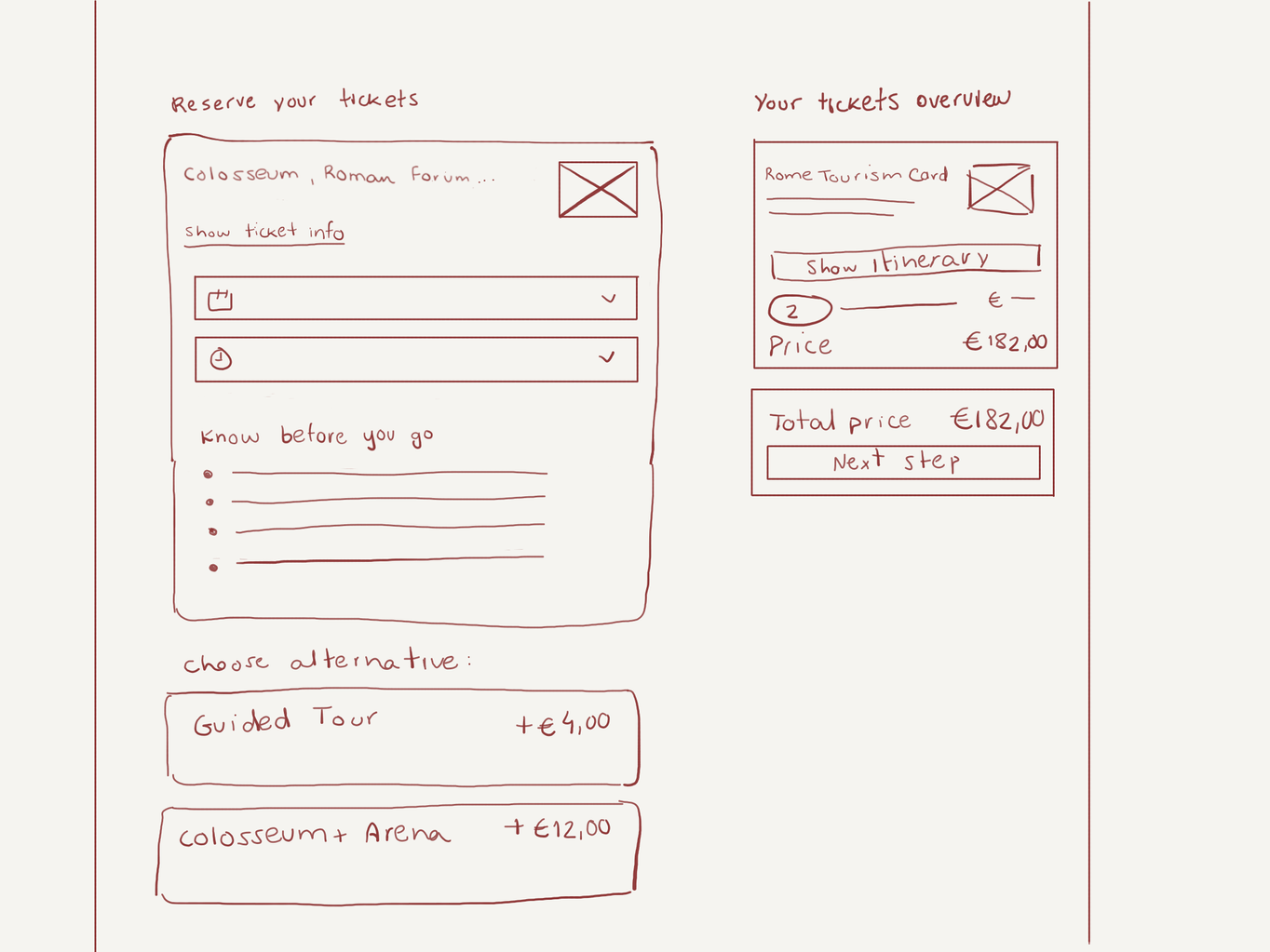
Prototype & testing
Together with our UX Researcher, we ran 5 sessions of prototype testing with a mix of Tiqets and non-Tiqets customers to uncover any usability issues with the current prototype.
Some of the learnings of the user testing were:
- Users couldn't find the place where to get more information about the specific tickets
- When a product is unavailable, some users felt like they were being pushed to pay more
- Showing the next available date helped clear up confusion around why a product was unavailable
After iterating on those findings, we launched the designs as an A/B test. The results were even more positive than we hoped:
Impact
The A/B test results went well beyond our original goal of a 10% conversion lift: offering alternative products at checkout increased conversion rate by 138%, while gross margin per user grew by 63% as customers opted into higher-value alternatives instead of leaving empty-handed.
The redesign also helped the Rome Tourist Card set a new sales record in its first month post-launch, validating that giving customers a way forward when their first choice sells out is worth more than the availability constraint it was designed to work around.
Final designs